Dog Urine Neutralizer for Outdoor Grass and Turf Surfaces
- Why dog urine smells so persistent outdoors
- The two main types of outdoor urine neutralizers
- Enzyme-based cleaners
- Oxidation-based cleaners
- Artificial turf: the surface that demands the most from a neutralizer
- Natural grass and other outdoor surfaces
- What to look for in an outdoor dog urine neutralizer
- How PurOxy approaches outdoor odor elimination
- Comparing approaches side by side
- How to use a urine neutralizer on artificial turf
- Frequently asked questions
- The right neutralizer makes the difference
If your backyard smells like a dog run no matter how many times you hose it down, you are dealing with a chemistry problem, not a cleaning frequency problem. A good dog urine neutralizer for outdoor surfaces has to do more than rinse away visible residue. It has to break down the ammonia compounds that cause the smell in the first place. This article explains why odor keeps coming back, what actually works on grass and artificial turf, and how to choose the right product for your yard.
Why dog urine smells so persistent outdoors
Dog urine contains urea, creatinine, and ammonia-based compounds. When urine dries on a surface, those compounds bind to the material and concentrate. On natural grass, soil microbes can eventually break some of it down, but the process is slow and incomplete, especially in dry or hot weather.
On artificial turf, the problem is worse. Synthetic fibers do not absorb and filter the way soil does. Urine pools in the infill layer, dries, and stays there. Every warm day reactivates the odor. Rain can dilute it temporarily, but the ammonia compounds remain. Hose rinsing spreads the residue without neutralizing it.
This is why fragrance-based products fail within hours. The odor source is still sitting in the infill.
The two main types of outdoor urine neutralizers
Enzyme-based cleaners
Enzyme cleaners use biological agents, typically bacteria that produce enzymes, to digest organic waste. They work well under the right conditions: moderate temperature, adequate moisture, and enough dwell time for the bacteria to activate.
Outdoors, those conditions are rarely consistent. In summer heat, enzyme activity slows or stops. UV exposure degrades the biological components. On dry artificial turf, there is not enough moisture to sustain the process. Products like Nature's Miracle Outdoor and Simple Green Outdoor are enzyme-based and widely available, but they were not formulated specifically for artificial turf, and their performance can vary significantly depending on the season and surface temperature.
Enzyme cleaners are not a bad product category. They have real applications indoors and in controlled environments. The problem is that outdoor turf in warm weather is close to the worst possible environment for enzyme biology.
Oxidation-based cleaners
Hydrogen peroxide works through a different mechanism entirely. It oxidizes ammonia compounds on contact, breaking the molecular bonds that produce the odor. This is a chemical reaction, not a biological one. It does not require a specific temperature range, a moisture window, or dwell time measured in hours.
The reaction happens quickly. A stabilized hydrogen peroxide formula applied to artificial turf or concrete can neutralize urine odor at the source in under ten minutes. The byproducts of the reaction, primarily water and oxygen, are benign, which is why hydrogen peroxide-based cleaners can carry biodegradable and pet-safe claims.
This is also why hydrogen peroxide is not an enzyme cleaner. The two categories use completely different chemistry, and hydrogen peroxide does not rely on bacteria or enzyme activity at all.
Artificial turf: the surface that demands the most from a neutralizer
Artificial turf is where urine odor is hardest to eliminate and where product choice matters most. The infill, often crumb rubber or sand, traps urine below the fiber layer. Standard spray cleaners may coat the fibers without reaching the infill where the odor actually lives.
A product formulated specifically for artificial turf accounts for this. It needs enough penetration to reach the infill, a chemistry that works on contact rather than requiring a biological activation window, and a formula that does not degrade the synthetic fibers over repeated use.
If you have invested $5,000 to $15,000 in a synthetic turf installation, the last thing you want is a cleaner that shortens the life of the turf or leaves behind a residue that attracts more bacteria.
Natural grass and other outdoor surfaces
On natural grass, urine odor is usually less persistent because soil biology helps break down organic compounds over time. But in spots where dogs return repeatedly, the soil becomes saturated and the odor becomes chronic. A hydrogen peroxide-based neutralizer applied directly to those spots can break down the ammonia load without harming the grass at the concentrations used in consumer products.
Concrete, pavers, and dog run surfaces present their own challenge. Porous concrete absorbs urine and holds it. Repeated cleaning with fragrance-based products just layers scent on top of the problem. An oxidizing cleaner reaches into the pores and breaks down the compounds rather than covering them.
Kennels and dog runs benefit from the same approach, especially when a cleaner requires no mixing and no rinse, which makes daily maintenance practical rather than a chore.
What to look for in an outdoor dog urine neutralizer
Not every product marketed as a urine neutralizer actually neutralizes anything. Here is what separates effective products from ones that just smell better for a few hours:
- The active mechanism should be oxidation or enzymatic digestion, not fragrance. If the first listed benefit is a scent, the product is a masking agent.
- The formula should be rated for outdoor conditions, including heat and UV exposure. Indoor enzyme cleaners repurposed for outdoor use often underperform.
- Ready-to-use formats save time and reduce the risk of incorrect dilution. Products that require mixing introduce inconsistency.
- No bleach and no phosphates are worth checking on the label if you have kids or pets using the same space.
- Surface compatibility should be confirmed for your specific surface, whether that is artificial turf, concrete, natural grass, or pavers.
How PurOxy approaches outdoor odor elimination
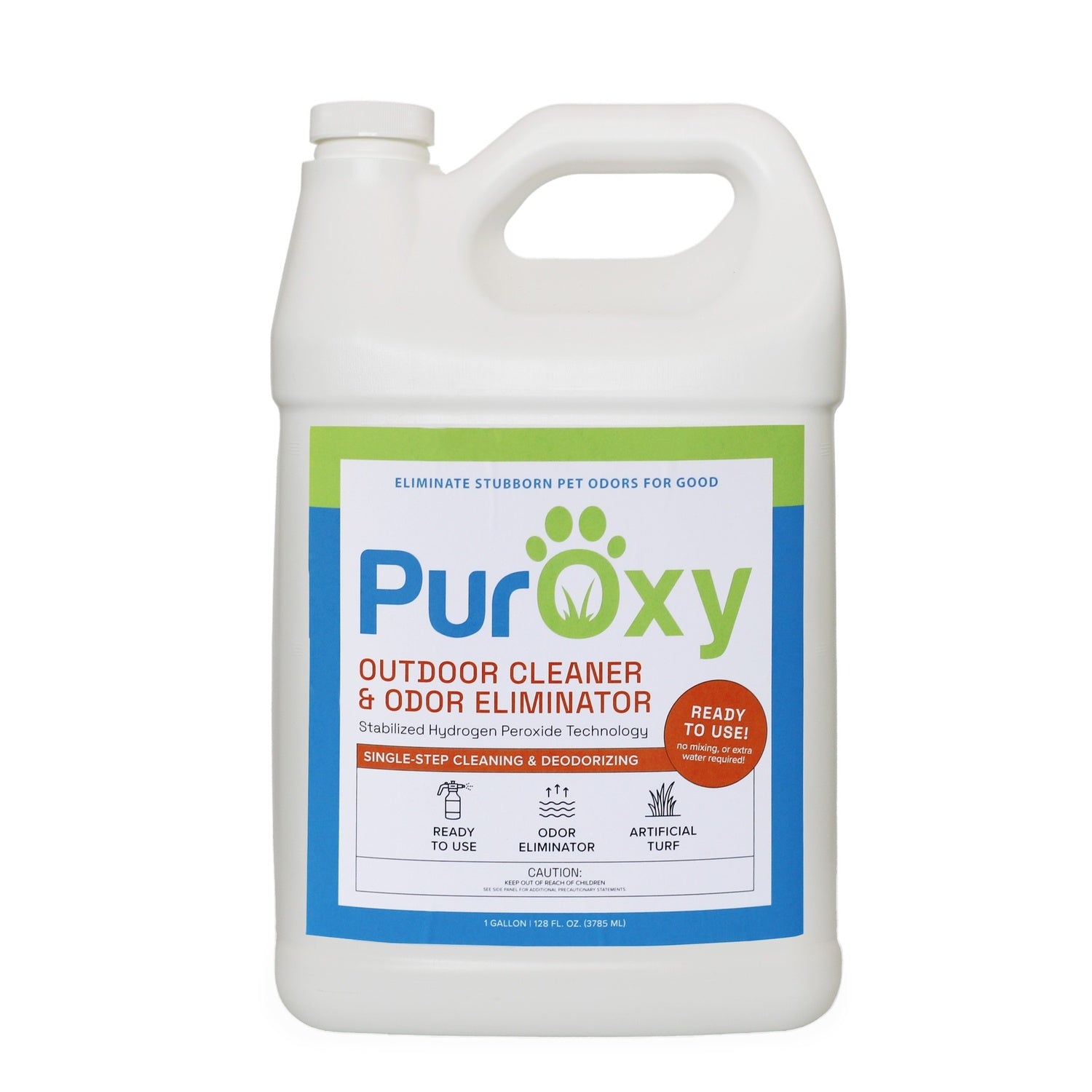
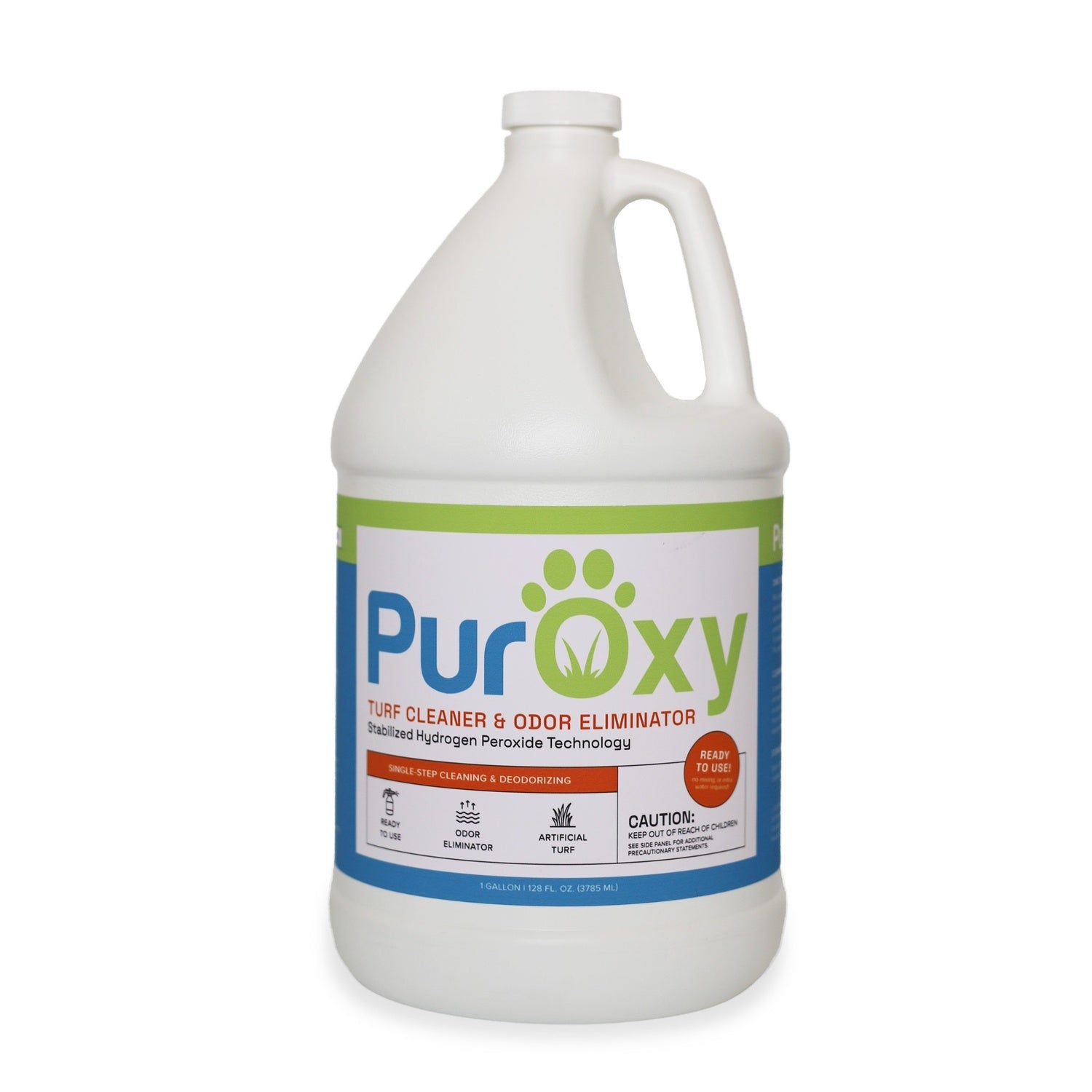
PurOxy uses 6% stabilized hydrogen peroxide as its active ingredient. The formula oxidizes ammonia compounds in dog urine on contact, working through chemistry rather than biology, with no dependence on temperature or moisture conditions to activate.
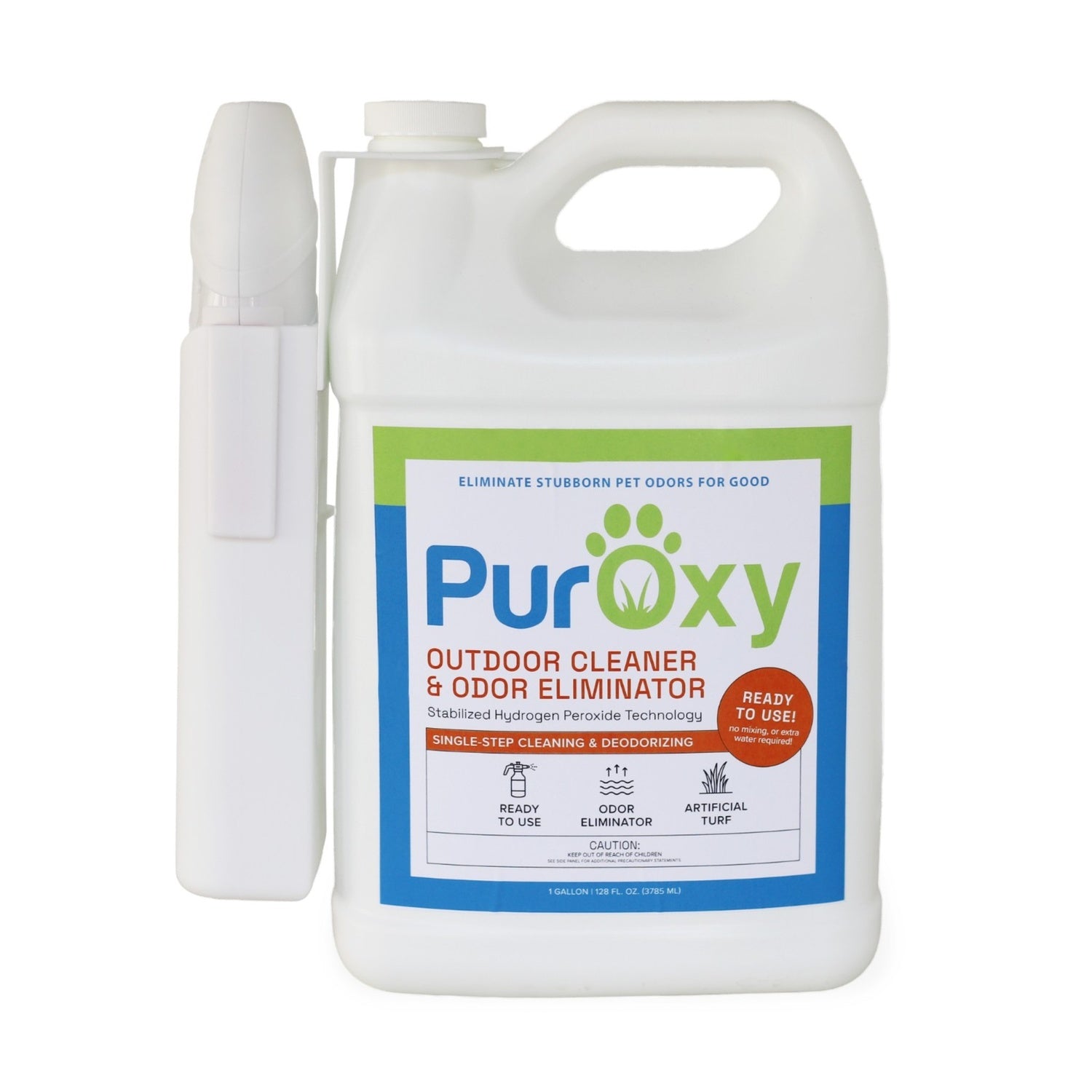
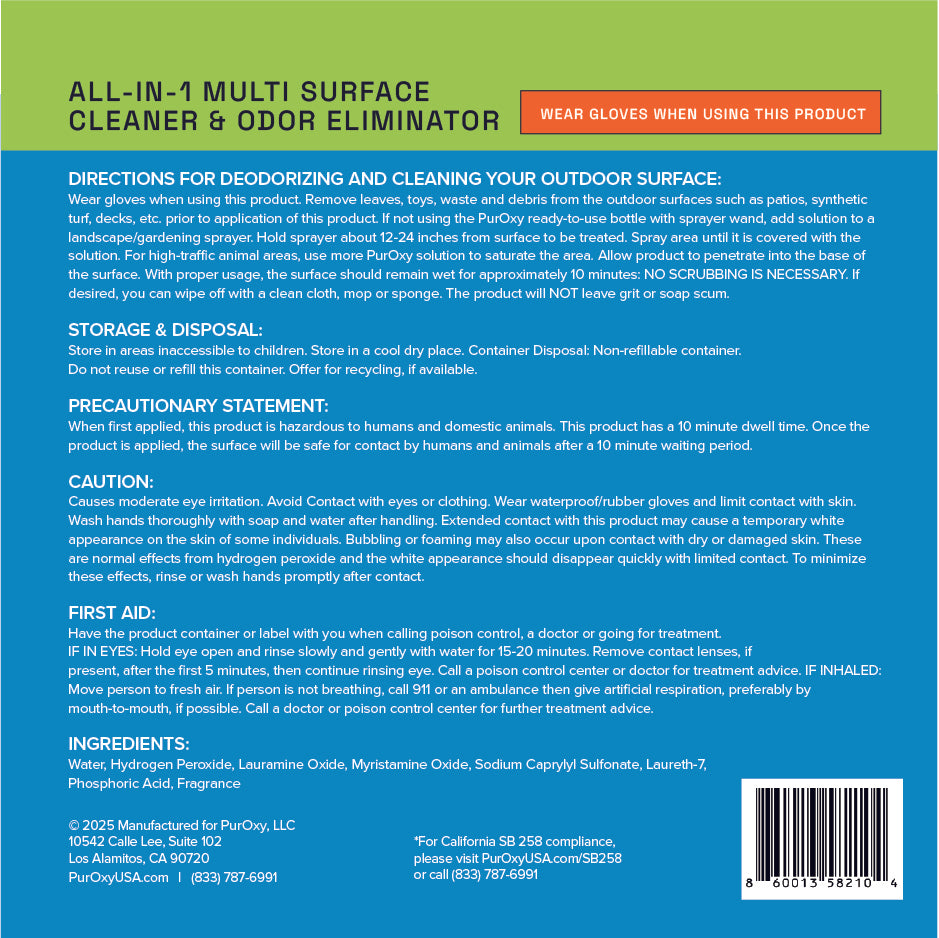
It is ready to use straight from the bottle. No mixing, no pre-cleaning, no rinsing required. Spray it on the affected surface and the reaction begins immediately, with results in under ten minutes. The formula contains no bleach and no phosphates, is biodegradable, and is rated safe for daily use around children and pets.
PurOxy is formulated specifically for outdoor surfaces, with artificial turf as the primary use case. It does not degrade turf fibers with repeated use, which matters for anyone who wants their turf installation to last. It also works on concrete, pavers, dog runs, kennels, and patios.
The product is available in sizes from a 32 oz trigger spray to a 1-gallon refill, with bulk options for kennels and commercial users. Orders over $45 ship free.
Comparing approaches side by side
| Approach | Works in heat and UV | Turf-specific | Ready to use | Eliminates odor at source |
|---|---|---|---|---|
| Hydrogen peroxide oxidation | Yes | Depends on product | Depends on product | Yes |
| Enzyme cleaners | Inconsistent | Rarely | Usually | Yes, when active |
| Fragrance masking agents | Yes | No | Yes | No |
| Professional cleaning service | Yes | Yes | N/A | Yes |
The professional cleaning service option, which typically runs $200 to $350 per visit, is effective but not practical for weekly or daily maintenance. A DIY oxidation-based cleaner fills that gap.
How to use a urine neutralizer on artificial turf
The process is straightforward with a ready-to-use formula:
- Identify the affected areas. High-traffic spots where your dog returns consistently will have the strongest odor concentration.
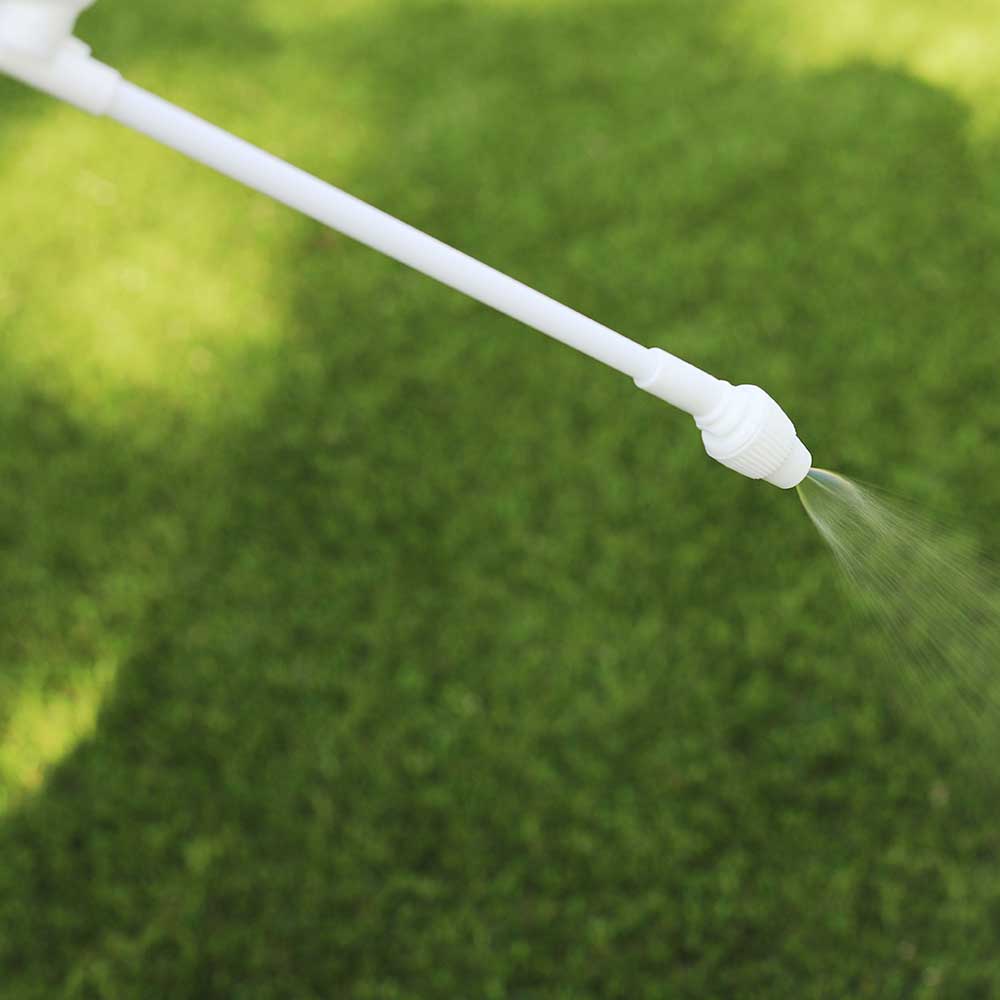
- Apply the neutralizer directly to the surface. No pre-wetting or scrubbing needed.
- Let it dwell for the time specified on the label. For PurOxy, that is under ten minutes.
- No rinsing required. The oxidation reaction breaks down the ammonia compounds and the byproducts dissipate naturally.
For maintenance, applying after each use, or at least several times per week in active areas, prevents odor from building up in the infill. Waiting until the smell is noticeable means the ammonia load is already high, and a single application may not be enough to fully clear it.
Frequently asked questions
What is the difference between a urine neutralizer and a urine cleaner? A cleaner removes visible residue and surface contamination. A neutralizer breaks down the chemical compounds that cause odor, specifically ammonia and related molecules. Some products do both; others only clean the surface without addressing the smell at the molecular level. For persistent outdoor odor, you need a product that neutralizes, not just cleans.
Does hydrogen peroxide actually neutralize dog urine smell? Yes. Hydrogen peroxide oxidizes the ammonia compounds in urine, breaking the bonds responsible for the odor. This is a chemical reaction that happens on contact and does not require heat, moisture, or biological activation. It works through a different mechanism than enzyme cleaners, which rely on bacterial activity.
Why does my artificial turf still smell after I clean it? Most likely because the product you are using is masking the odor rather than eliminating it, or because it is not reaching the infill layer where the urine has settled. Enzyme cleaners may also underperform in hot, dry outdoor conditions. A hydrogen peroxide-based formula formulated for turf penetrates to the odor source and breaks it down chemically.
Is hydrogen peroxide safe for artificial turf? At the concentrations used in consumer cleaning products, stabilized hydrogen peroxide does not degrade synthetic turf fibers. Products formulated specifically for artificial turf, like PurOxy, are designed for repeated use without shortening the life of the installation.
Can I use a dog urine neutralizer on natural grass? Yes, for spot treatment in areas where odor has become chronic. A hydrogen peroxide-based formula at consumer concentrations will not harm grass and can break down the ammonia buildup in saturated soil patches. For large lawn areas, dilution and coverage become practical considerations.
How often should I apply a urine neutralizer to artificial turf? For active use areas, several times per week is a reasonable maintenance schedule. Daily application is safe with a formula rated for daily use. The goal is to prevent ammonia from accumulating in the infill rather than waiting until the odor is strong enough to notice.
Are enzyme cleaners ever a good choice for outdoor turf? In mild, temperate conditions with adequate moisture, enzyme cleaners can work. The problem is that outdoor turf in summer is close to the worst possible environment for enzyme biology: high heat, UV exposure, and dry surfaces all reduce effectiveness. If you live in a warm climate or are cleaning during summer months, an oxidation-based formula is more reliable.
The right neutralizer makes the difference
Persistent dog urine odor outdoors is a chemistry problem. Hose rinsing dilutes it. Fragrance products cover it. Only a formula that breaks down the ammonia compounds at the molecular level actually eliminates it. On artificial turf especially, where urine concentrates in the infill and reactivates with every warm day, the choice of chemistry matters more than the frequency of cleaning.
If you want a ready-to-use option that works in under ten minutes and is safe for daily use around kids and pets, visit puroxyusa.com to see the full product range.